The Meaning of Chinas Most Ancient Art an Interpretation of Pottery By Anneliese Bulling

Chinese art traditions are the oldest continuous fine art traditions in the world. Early so-called "stone age art" in Communist china, consisting mostly of unproblematic pottery and sculptures, dates dorsum to 10,000 B.C.E.. This early menstruation was followed past a serial of dynasties, most of which lasted several hundred years. Through dynastic changes, political collapses, Mongol and Manchurian invasions, wars, and famines, Chinese artistic traditions were preserved by scholars and nobles and adapted by each successive dynasty. The fine art of each dynasty can exist distinguished by its unique characteristics and developments.
Contents
- ane Historical development to 221 B.C.E.
- 1.one Neolithic pottery
- 1.two Jade culture
- ane.iii Bronze casting
- 1.4 Early Chinese music
- 1.five Early Chinese poetry
- 1.six Chu and Southern civilisation
- 2 Early Regal Cathay (221 B.C.E.– 220 C.E.)
- 2.1 Qin sculpture
- 2.two Pottery
- 2.three TLV Mirrors
- ii.4 Han poetry
- 2.5 Han newspaper art
- 2.6 Other Han fine art
- 3 Period of Division (220–581)
- 3.ane Influence of Buddhism
- 3.2 Poetry
- 3.3 Calligraphy
- 4 The Sui and Tang dynasties (581–960)
- 4.ane Buddhist architecture and sculpture
- 4.2 Gold age of Chinese poesy
- 4.3 Li Po and Du Fu
- 4.four Belatedly Tang verse
- 4.5 Painting
- 5 Song and Yuan dynasties (960–1368)
- 5.1 Song verse
- 5.2 Song painting
- five.3 Yuan drama
- 5.4 Yuan painting
- half-dozen Belatedly imperial China (1368-1911)
- 6.one Ming poesy
- 6.two Ming prose
- 6.3 Ming painting
- six.four Qing drama
- 6.v Qing poetry
- 6.6 Early on Qing painting
- 6.vii Shanghai School (1850 – 1890)
- 6.eight Qing fiction
- 7 New China Art (1912-1949)
- 7.i Transformation
- 7.2 The Big Three
- 7.3 Comics
- 7.4 Painting
- vii.5 Guohua
- viii Communist art (1950-1980s)
- eight.1 The loss of the Big Iii
- 8.2 Painting
- 8.3 Poesy
- 9 Redevelopment (Mid-1980s - 1990s)
- 9.1 Contemporary Fine art
- ix.ii Visual art
- 10 Contemporary Chinese art market
- 10.1 The new visual fine art marketplace
- 11 See also
- 12 Notes
- thirteen References
- 14 External links
- fifteen Credits
Jade carvings and bandage bronzes are amongst the primeval treasures of Chinese art. The origins of Chinese music and poetry can be plant in the Book of Songs, containing poems equanimous between 1000 B.C.E. and 600 B.C.East.. The earliest surviving examples of Chinese painting are fragments of painting on silk, stone, and lacquer items dating to the Warring States period (481 - 221 B.C.E.). Paper, invented during the first century C.Due east., later replaced silk. Beginning with the establishment of the Eastern Jin Dynasty (265–420)|, painting and calligraphy were highly appreciated arts in courtroom circles. Both used brushes and ink on silk or paper. The earliest paintings were figure paintings, followed later on past landscapes and bird-and-flower paintings. Confucianism, Daoism and Buddhism powerfully influenced the subjectmatter and style of Chinese art.
Historical development to 221 B.C.E.
Neolithic pottery

Black eggshell pottery of the Longshan culture (c. 3000–2000 B.C.E.)
Early forms of fine art in China are found in the Neolithic Yangshao culture (Chinese: 仰韶文化; pinyin: Yǎngsháo Wénhuà), which dates back to the sixth millennium B.C.Eastward. Archeological findings such as those at the Banpo have revealed that the Yangshao fabricated pottery; early ceramics were unpainted and most often ornamented by with marks made by pressing cords into the wet dirt. The outset pictorial decorations were fish and human faces, which eventually evolved into symmetrical-geometric abstract designs, some painted.
The nearly distinctive feature of Yangshao culture was the extensive use of painted pottery, especially human facial, animal, and geometric designs. Unlike the after Longshan culture, the Yangshao culture did non employ pottery wheels in pottery making. According to archaeologists, Yangshao society was based around matriarchal clans. Excavations have found that children were buried in painted pottery jars.
Jade culture

Jade bi from the Liangzhu culture. The ritual object is a symbol of wealth and military power.
Tools such as hammer heads, ax heads and knives were made of jade nephrite during the Neolithic menstruum (c. 12,000 – c. 2,000 B.C.E.). The Liangzhu culture, the terminal Neolithic jade civilisation in the Yangtze River delta, lasted for a period of about 1300 years from 3400 - 2250 B.C.Eastward. The jade from this civilisation is characterized by finely worked, big ritual jades such as Cong cylinders, Bi discs, Yue axes, pendants and decorations in the course of chiseled open-piece of work plaques, plates and representations of small birds, turtles and fish. Liangzhu jade has a white, milky bone-similar attribute due to its origin equally Tremolite rock and the influence of water-based fluids at the burial sites.
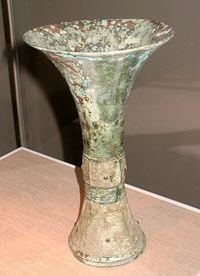
Shang Dynasty (Yin) statuary ritual wine vessel, dating to the thirteenth century B.C.E.
Bronze casting
The Bronze Age in China began with the Xia Dynasty (ca. 2100 – 1600 B.C.E.). Examples from this period accept been recovered from ruins of the Erlitou culture, in Shanxi, and include complex just unadorned utilitarian objects. In the following Shang Dynasty (商朝) or Yin Dynasty (殷代) (ca. 1600 - ca. 1100 B.C.Due east.), more elaborate objects, including many ritual vessels, were crafted. The Shang are recognized for their bronze casting, noted for its clarity of detail. Excavations testify that Shang bronzesmiths unremarkably worked in foundries outside the cities and made ritual vessels, weapons and sometimes chariot fittings. The bronze vessels were receptacles for storing or serving diverse solids and liquids used in the functioning of sacred ceremonies. Some forms such as the ku and jue can exist very graceful, but the most powerful pieces are the ding, sometimes described as having an "air of ferocious majesty."
It is typical of the adult Shang mode that all available infinite is decorated, most often with stylized forms of real and imaginary animals. The most mutual motif is the taotie, a symmetrical zoomorphic mask, presented frontally, with a pair of eyes and typically no lower jaw area. The early significance of taotie is not clear, but myths near information technology existed effectually the tardily Zhou Dynasty (周朝; 1122 B.C.East. to 256 B.C.E.). It was considered to be variously a covetous man banished to guard a corner of heaven against evil monsters; or a monster equipped with only a head which tries to devour men but hurts but itself.
The part and appearance of bronzes altered gradually from the Shang to the Zhou, and they began to exist used for practical purposes also equally in religious rites. Past the Warring States Period (fifth century B.C.E. to 221 B.C.E.), bronze vessels had become objects of aesthetic enjoyment. Some were decorated with scenes of social life, such as banquets or hunts; while others displayed abstruse patterns inlaid with gold, silverish, or precious and semiprecious stones.
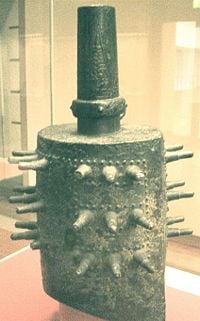
Shang bronzes became appreciated as works of fine art during the Song Dynasty (960 – 1279 C.East.), when they were collected and prized non only for their shape and design but besides for the various light-green, blue green, and even ruddy patinas created past chemical action every bit they lay buried in the ground. The study of early on Chinese bronze casting is a specialized field of fine art history.
Early Chinese music
The origins of Chinese music and poetry tin exist institute in the Book of Songs, containing poems composed between 1000 B.C.E. and 600 B.C.Due east.. The text, preserved amidst the canon of early Chinese literature, contains folk songs, religious hymns and stately songs. Originally intended to be sung, the music accompanying the words has unfortunately been lost. The songs were written for a variety of purposes, including courting, ceremonial greetings, warfare, feasting and lamentation. The love poems are among the nigh highly-seasoned in the freshness and innocence of their language.
Early Chinese music was based on percussion instruments such as the bronze bell. Chinese bells were sounded by beingness struck from the outside, usually with a piece of forest. Sets of bells were suspended on wooden racks. Inside excavated bells are grooves, scrape marks and scratches made as the bells were tuned to the right pitch by removing small amounts of metal. Percussion instruments gradually gave style to cord and reed instruments toward the Warring States flow.

Significantly, the Chinese character for the word music (yue) was the same as that for joy (le). Confucians believed music had the power to make people harmonious and well counterbalanced, or to cause them to be quarrelsome and depraved. According to Xun Zi, music was every bit important as the li (rites, etiquette) stressed in Confucianism. Mozi, philosophically opposed to Confucianism, dismissed music every bit useless and wasteful, having no practical purpose.
Early on Chinese verse
In addition to the Book of Songs (Shi Jing), a second early on and influential poetic anthology was the Songs of Chu (Simplified Chinese: 楚辞; Traditional Chinese: 楚辭; pinyin: Chǔ Cí), made upwardly primarily of poems ascribed to the semilegendary Qu Yuan (c. 340–278 B.C.E.) and his follower Song Yu (fourth century B.C.E.). The songs in this drove are more than lyrical and romantic and correspond a different tradition from the earlier Classic of Poesy (Shi Jing).
Chu and Southern civilization
A rich source of art in early China was the land of Chu (722 – 481 B.C.Eastward.), which developed in the Yangtze River valley. Painted wooden sculptures, jade disks, drinking glass chaplet, musical instruments, and an array of lacquerware have been plant in excavations of Chu tombs. Many of the lacquer objects are finely painted, red on blackness or black on ruddy. The world's oldest painting on silk discovered to date was found at a site in Changsha, Hunan province. It shows a adult female accompanied by a phoenix and a dragon, ii mythological animals that characteristic prominently in Chinese art.
An anthology of Chu poetry has as well survived in the form of the Chu Ci, which has been translated into English by David Hawkes. Many of the works in the text are associated with Shamanism. At that place are also descriptions of fantastic landscapes, examples of Cathay's beginning nature poetry. The longest poem, "Encountering Sorrow," is reputed to take been written by the tragic Qu Yuan equally a political allegory.
Early Imperial Communist china (221 B.C.Eastward.– 220 C.E.)
Qin sculpture
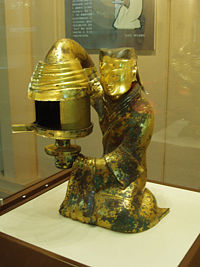
A gilded bronze lamp with a shutter, in the shape of a maidservant, from the Western Han Dynasty, 2nd century B.C.E.
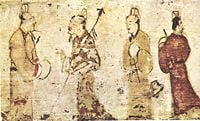
Two gentlemen engrossed in conversation while two others await on, a painting on a ceramic tile from a tomb near Luoyang, Henan province, dated to the Eastern Han Dynasty (25–220 C.E.)
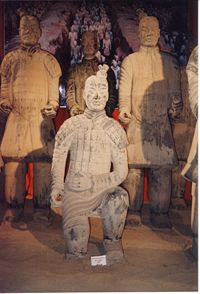
The Terracotta Army, inside the Mausoleum of the First Qin Emperor, consists of more than seven thousand life-size tomb terra-cotta figures of warriors and horses buried with the self-proclaimed first Emperor of Qin (Qin Shi Huang) in 210–209 B.C.E..
The figures were painted before beingness placed into the vault. The original colors were visible when the pieces were outset unearthed, simply exposure to air acquired the pigments to fade. The figures are in several poses including standing infantry and kneeling archers, equally well as charioteers with horses. The caput of each effigy appears to exist unique; the figures exhibit a variety of facial features and expressions also as hair styles.
Pottery
Porcelain is made from a hard paste comprised of the dirt kaolin and a feldspar called petuntse, which cements the vessel and seals whatever pores. The word communist china (chinaware) has become synonymous with high-quality porcelain. Most people's republic of china comes from the city of Jingdezhen in China'south Jiangxi province. Jingdezhen, nether a variety of names, has been central to porcelain production in Mainland china since at least the early Han Dynasty (206 B.C.E.–220 C.E.).
The most noticeable difference betwixt porcelain and other pottery clays is that it "wets" very quickly (that is, added water has a noticeably greater effect on the plasticity of porcelain clays), and that it tends to go on to "movement" longer than other clays, requiring experience in treatment to accomplish optimum results. Porcelain is fired at very high temperatures and the upshot is a translucent quality, assuasive light to penetrate the finished product.
In medieval Europe, Chinese porcelain was very expensive and much sought after for its beauty.
TLV Mirrors
Bronze mirrors, called TLV mirrors considering symbols resembling the messages T, L, and 5 are engraved into them, became popular during the Han Dynasty. They were produced from effectually the second century B.C.E. until the second century C.Due east.. The dragon was an important symbol on early TLV mirrors, appearing as arabesques on early on mirrors and afterwards as fully-fledged figures.[1] In the later on role of the Western Han menstruum, the dragons were replaced past winged figures, monsters and immortals.
Mirrors from the Xin Dynasty (eight-23 C.Due east.) usually accept an outer band with cloud or animal motifs, and an inner circle with a square containing a knob. The inner circle oftentimes contains a serial of eight 'nipples,' and various mythological animals and beings, including the Queen Mother of the West.[ii] The fundamental foursquare could have an inscription, or contain the characters of the Twelve Earthly Branches. Inscriptions placed in betwixt the mirror'due south sections oft talk over Wang Mang and his reign.[3]
Han poetry
During, the Han Dynasty, Chu lyrics evolved into the fu (賦), a poem unremarkably in rhymed poetry except for introductory and concluding passages that are in prose, often in the form of questions and answers.
From the Han Dynasty onwards, a procedure similar to the official compilation of the Shi Jing produced yue fu (Traditional Chinese: 樂府; Simplified Chinese: 乐府; Hanyu Pinyin: yuèfǔ) poems, composed in a folk song mode. "Yue fu" literally ways "music agency," a reference to the government organization originally charged with collecting or writing the lyrics. The lines are of uneven length, though 5 characters is the most common. Each poem follows 1 of a serial of patterns defined past the song championship. Yue fu includes original folk songs, court imitations and versions by known poets such as Li Bai).
Han paper art
The invention of paper during the Han dynasty[4] spawned two new Chinese arts. Chinese paper cut originated equally a pastime amid the nobles in royal palaces[5]. The Song Dynasty scholar Chou Mi mentioned several paper cutters who cut paper with pair of scissors into a great variety of designs and characters in unlike styles, and a immature man who could even cut characters and flowers inside his sleeve[6]. The oldest surviving paper cut out is a symmetrical circle from the sixth century found in Xinjiang, China[six].
The art of Chinese paper folding also originated in the Han dynasty, later developing into origami after Buddhist monks introduced paper to Japan[7].
Other Han art
The Han Dynasty was also known for jade burial suits, made of thousands of jade plates threaded together with gilt, silver or copper wire, or with silk threads. Ane of the primeval known depictions of a landscape in Chinese fine art comes from a pair of hollow-tile door panels from a Western Han Dynasty tomb virtually Zhengzhou, dated 60 B.C.E. [8] A scene of continuous depth recession is conveyed past the zigzag of lines representing roads and garden walls, giving the impression that one is looking down from the top of a hill.[8] This creative mural scene was made by the repeated impression of standard stamps on the dirt while information technology was still soft and not yet fired.[eight]
Period of Sectionalisation (220–581)

A scene of two horseback riders from a wall painting in the tomb of Lou Rui at Taiyuan, Shanxi, Northern Qi Dynasty (550–577)
Influence of Buddhism
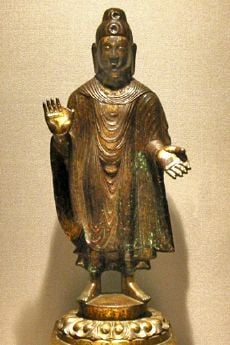
A Chinese Northern Wei Buddha Maitreya, 443 C.E.
Buddhism arrived in China around the offset century C.E. (although some traditions tell of a monk visiting Prc during Asoka's reign), and for the next 7 centuries China became very active in the development of Buddhist fine art, specially in the surface area of statuary. Strong Chinese traits were soon incorporated in Buddhist artistic expression.
From the fifth to sixth century, the Northern Dynasties, physically distant from the original sources of inspiration, developed symbolic and abstract modes of representation with schematic lines. Their style is solemn and majestic. The lack of corporeality of this art, and its distance from the original Buddhist objective of expressing the pure ideal of enlightenment in an attainable, realistic style, progressed towards more the natural and realistic expression of Tang Buddhist art.

Northern Wei wall murals and painted figurines from the Yungang Grottoes, dated 5th to 6th centuries.
Verse
Historical records indicate Cao Cao (155 – 220), the father of the well-known poets Cao Pi (187 – 226) and Cao Zhi (192 – 232), was himself a bright ruler and poet. Cao Pi is known for writing the first Chinese poem using 7 syllables per line (七言詩), the verse form 燕歌行. Cao Zhi demonstrated his spontaneous wit at an early on age and was a favorite candidate for the throne; his brother Cao Pi rapidly took control after their begetter's death and Cao Zhi was never allowed to enter politics. Instead, he devoted his ability to Chinese literature and poesy, and surrounded himself with a grouping of poets and officials with literary interests. The poems of Cao Zhi, Cao Cao, and Cao Pi were representative of the solemn and stirring jian'an fashion (建安風骨), a transition from earlier folksongs into scholarly poesy. Lament over the ephemerality of life was a cardinal theme of works from this period. More than 60 of the 90 poems by Cao Zhi still in being are five-character poems (五言詩), considered to have strongly influenced the later evolution of 5-grapheme poetry.
The verse of Tao Qian (365 – 427) was an of import influence on the verse of the Tang and Vocal Dynasties. Approximately 120 of his poems survive, depicting an idyllic pastoral life of farming and drinking.
Calligraphy
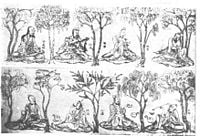
Seven Sages of the Bamboo Grove, an Eastern Jin (265-420) tomb painting from Nanjing, now located in the Shaanxi Provincial Museum.
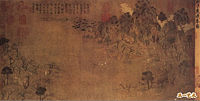
Strolling About in Spring, by Zhan Ziqian, creative person of the Sui Dynasty (581–618).

Function of the coil for Admonitions of the Instructress to the Palace Ladies, a Tang Dynasty duplication of the original by Gu Kaizhi.
In ancient Communist china, painting and calligraphy were the most highly appreciated arts in court circles and were produced almost exclusively past amateurs, aristocrats and scholar-officials who had the leisure to perfect the technique and sensibility necessary for great brushwork. Calligraphy was considered the highest and purest form of painting. The implements were the brush pen, made of animate being hair, and black inks, made from pine soot and beast gum. Writing as well equally painting was done on silk until the invention of paper in the first century. Original writings by famous calligraphers have been greatly valued throughout Prc's history.
Wang Xizhi (Chinese: 王羲之, 303–361), a famous Chinese calligrapher who lived in the 4th century C.E., is known for Lanting Xu, the preface to a collection of poems written by a number of poets who gathered at Lan Ting near the town of Shaoxing, in Zhejiang province, to engage in a game chosen "qu shui liu shang."
His teacher was Wei Shuo (Simplified Chinese: 卫铄; Traditional Chinese: 衛鑠; pinyin: Wèi Shuò, 272–349), ordinarily addressed as Lady Wei (衛夫人), a well-known calligrapher who established consequential rules for Regular Script. Her works include Famous Concubine Inscription (名姬帖 Ming Ji Tie) and The Inscription of Wei-shi He'nan (衛氏和南帖 Wei-shi He'nan Tie).
Gu Kaizhi (Traditional Chinese: 顧愷之; Simplified Chinese: 顾恺之; Hanyu Pinyin: Gù Kǎizhī; Wade-Giles: Ku Chiliad'ai-chih) (ca. 344-406), a historic painter born in Wuxi, wrote three books on painting theory: On Painting (画论), Introduction of Famous Paintings of Wei and Jin Dynasties (魏晋胜流画赞) and Painting Yuntai Mountain (画云台山记). He wrote, "In figure paintings the clothes and the appearances were non very important. The eyes were the spirit and the decisive factor."
Iii of Gu's paintings nevertheless survive: "Admonitions of the Instructress to the Court Ladies," "Nymph of the Luo River" (洛神赋), and "Wise and Chivalrous Women."
Other examples of Jin Dynasty painting have been found in tombs. 7 Sages of the Bamboo Grove, painted on a brick wall of a tomb located near modern Nanjing and now found in the Shaanxi Provincial Museum, depicts a famous group of seven Daoist scholars, each labeled and shown either drinking, writing, or playing a musical instrument. Other tomb paintings portray scenes of daily life, such every bit men plowing fields with teams of oxen.
The Sui and Tang dynasties (581–960)
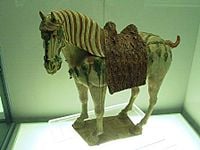
A Chinese Tang Dynasty tri-color glazed porcelain horse (ca. 700 C.Due east.), using yellow, greenish and white colors.
The Tang period was considered the golden age of Chinese literature and art.
Buddhist compages and sculpture
Post-obit a transition under the Sui Dynasty, Buddhist sculpture of the Tang evolved towards markedly lifelike expression. Buddhism connected to flourish during the Tang period and was adopted past the royal family, becoming thoroughly sinicized and a permanent part of Chinese traditional culture. Equally a consequence of the Dynasty's openness to foreign influences, and renewed exchanges with Indian culture due to the numerous travels of Chinese Buddhist monks to India from the quaternary to the eleventh century, Tang dynasty Buddhist sculpture assumed a classical course, inspired by the Indian fine art of the Gupta period. Towards the end of the Tang dynasty foreign influences came to be negatively perceived. In the year 845, the Tang emperor Wu-Tsung outlawed all "strange" religions (including Christian Nestorianism, Zoroastrianism and Buddhism) in order to support the indigenous Daoism. He confiscated Buddhist possessions and forced the organized religion to become cloak-and-dagger, affecting the further evolution of the religion and its arts in Prc.
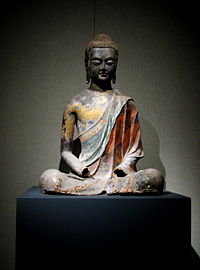
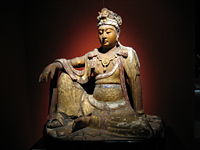
Seated Mahayana Buddha statue, Tang dynasty
Most wooden Tang sculptures have not survived, though representations of the Tang international way can still be seen in Nara, Japan. Some of the finest examples of Tang rock sculpture can be seen at Longmen, near Luoyang, Yungang near Datong, and Bingling Temple, in Gansu.
1 of the about famous Buddhist Chinese pagodas is the Giant Wild Goose Pagoda, built in 652 C.E..
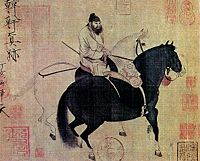
A Man Herding Horses, by Han Gan (706-783 C.E.), Tang Dynasty original.
Gilded age of Chinese poesy
From the 2nd century C.E., yue fu (Chinese poems composed in the style of folk songs) began to develop into shi—the form which was to dominate Chinese verse until the mod era. The writers of these poems took the five-grapheme line of the yue fu and used it to express more circuitous ideas. The shi verse form was mostly an expression of the poet's personal nature rather than the adopted characters of the yue fu; many were romantic nature poems heavily influenced by Daoism.
The Chinese term gushi ("old poems") refers either to the mostly anonymous shi poems, or more more often than not to the poems written in the same form by later on poets. Gushi are singled-out from jintishi (regulated poetry); the writer of gushi was under no formal constraints other than line length and rhyme (in every second line).
Jintishi, or regulated verse, developed from the 5th century onwards. Past the Tang dynasty, a series of set tonal patterns had been adult, which were intended to ensure a balance between the four tones of classical Chinese in each couplet: the level tone, and the three deflected tones (rising, falling and entering). The Tang dynasty was the high signal of the jintishi.
Notable poets from this era include Bai Juyi, Du Mu, Han Yu, Jia Dao, Li Qiao, Liu Zongyuan, Luo Binwang, Meng Haoran, Wang Wei, and Zhang Jiuling.
Li Po and Du Fu
Li Po and Du Fu, regarded by many as the greatest of the Chinese poets, both lived during the Tang Dynasty.

The Leshan Behemothic Buddha, 71 meters alpine, structure began in 713 C.E., completed ninety years after.
Over a thousand poems are attributed to Li Po, but the actuality of many of these is uncertain. He is best known for his intense and imaginative yue fu poems. Li Po is associated with Daoism, but his gufeng ("ancient airs") often adopt the perspective of the Confucian moralist. He composed approximately 160 jueju (five- or seven-graphic symbol quatrains) on nature, friendship, and acute observations of life. Some poems, like Changgan xing (translated by Ezra Pound as A River Merchant'southward Wife: A Alphabetic character), tape the hardships or emotions of common people.
Since the Vocal dynasty, critics have called Du Fu the "poet historian." The about straight historical of his poems are those commenting on military tactics or the successes and failures of the government, or the poems of advice which he wrote to the emperor.
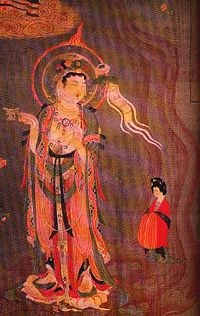
Tang Dynasty mural painting from Dunhuang.
One of the Du Fu'due south earliest surviving works, The Song of the Wagons (c. 750), gives vox to the sufferings of a conscript soldier in the imperial ground forces, even before the beginning of the rebellion. Du Fu mastered all the forms of Chinese poesy and used a broad range of registers, from the direct and colloquial to the allusive and self-consciously literary.
Late Tang poesy
Li Shangyin, a Chinese poet typical of the late Tang dynasty, wrote works that were sensuous, dumbo and allusive. Many of his poems take political, romantic or philosophical implications.
Li Yu, the last ruler of the Southern Tang Kingdom, composed his best-known poems during the years after the Vocal formally concluded his reign in 975 and brought him back as a captive to the Song capital, Bianjing (at present Kaifeng). Li'due south works from this catamenia dwell on his regret for the lost kingdom and the pleasures information technology had brought him. He was finally poisoned by the Song emperor in 978. Li Yu developed the ci by broadening its scope from love to history and philosophy, particularly in his later works. He also introduced the two-stanza form, and made great use of contrasts between longer lines of 9 characters and shorter ones of three and v.
Painting
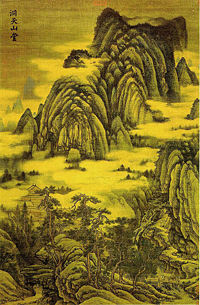
Painting by Dong Yuan (c. 934–962).
During the Tang dynasty (618–907), landscape painting (shanshui) became highly developed. These landscapes, unremarkably monochromatic and sparse, were not intended to reproduce exactly the appearance of nature only to evoke an emotion or atmosphere and capture the "rhythm" of nature.
The oldest known classical Chinese mural painting is a work by Zhan Ziqian of the Sui Dynasty (581–618), Strolling Virtually In Spring in which the mountains are arranged to show perspective.
Painting in the traditional manner involved essentially the same techniques as calligraphy and was washed with a brush dipped in blackness or colored ink on paper and silk. The finished work was then mounted on scrolls, which could exist hung or rolled upward. Traditional painting was also done in albums and on walls, lacquer work, and other media.
Dong Yuan, a painter of the Southern Tang Kingdom, was known for both figure and landscape paintings, and exemplified the elegant style which would get the standard for brush painting in China over the next 900 years. Like many Chinese painters, he was a government official. Dong Yuan studied and emulated the styles of Li Sixun and Wang Wei, but added new techniques including more than sophisticated perspective and the use of pointillism and crosshatching to build upwardly brilliant upshot.
Vocal and Yuan dynasties (960–1368)
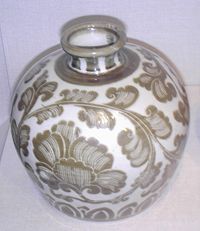
Song Dynasty ding-ware porcelain bottle with atomic number 26 pigment nether a transparent colorless glaze, eleventh century.
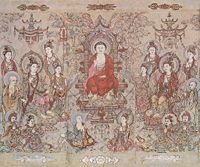
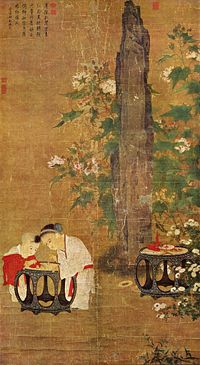
Playing Children, by Song artist Su Hanchen, c. 1150 C.E..
Song verse
Showtime in the Liang Dynasty, Ci lyric poesy followed the tradition of the Shi Jing and yue fu; lyrics from bearding popular songs (some of Central Asian origin) were adult into a sophisticated literary genre. The form was further developed during the Tang Dynasty, and was almost popular in the Vocal Dynasty.
Ci most often expressed feelings of want, frequently in an adopted persona, just the greatest exponents of the course (such as Li Houzhu and Su Shi) used information technology to accost a wide range of topics.
Well-known poets of the Song Dynasty include Zeng Gong, Li Qingzhao, Lu Y'all, Mei Yaochen, Ouyang Xiu, Su Dongpo, Wang Anshi, and Xin Qiji.
Song painting
During the Vocal dynasty (960–1279), landscapes of more subtle expression appeared; immeasurable distances were conveyed through the apply of blurred outlines, mountain contours disappearing into the mist, and impressionistic treatment of natural phenomena. Emphasis was placed on the spiritual qualities of the painting and on the ability of the creative person to reveal the inner harmony of human being and nature, as perceived according to Daoist and Buddhist concepts.
Liang Kai, a Chinese painter who lived in the thirteenth century (Song Dynasty), called himself "Madman Liang." He spent his life drinking and painting, eventually retiring to become a Zen monk. Liang is credited with inventing the Zen school of Chinese art.
Wen Tong, who lived in the eleventh century, was famous for ink paintings of bamboo. He could agree two brushes in one hand and paint two different bamboos simultaneously. He did not need to look at bamboo while he painted because he was so familiar with their appearance and graphic symbol.
Zhang Zeduan is noted for his horizontal cityscape Along the River During Qingming Festival, which has been copied many times throughout Chinese history.[9] Other famous paintings include The Night Revels of Han Xizai, originally painted past the Southern Tang creative person Gu Hongzhong in the tenth century. The best-known version of his painting is a twelfth century re-create from the Song Dynasty. The large horizontal hand scroll shows men of the gentry form existence entertained by musicians and dancers while enjoying food, potable, and beingness offered wash basins past maidservants.
Yuan drama
Chinese opera has its origins in the Tang dynasty. Emperor Xuanzong (712–755) founded the "Pear Garden" (梨园), the first known opera troupe in China, to perform for his personal enjoyment. Chinese operatic professionals are still referred to as "Disciples of the Pear Garden" (梨园子弟). In the Yuan dynasty (1279–1368), forms like the Zaju (杂剧, variety plays), in which dramas are based on rhyming schemes and incorporate specialized character roles similar "Dan" (旦, female), "Sheng" (生, male) and "Chou" (丑, Clown), were introduced into the opera.
Yuan dynasty opera exists today as Cantonese opera. It is universally accepted that Cantonese opera was imported from the northern function of China and slowly migrated to the southern province of Guangdong in late thirteenth century, during the late Southern Song Dynasty. In the 12th century, there was a theatrical form chosen Narm hei (南戲), or the Nanxi (Southern opera), which was performed in public theaters of Hangzhou, then uppercase of the Southern Song Dynasty. When the Mongol regular army invaded in 1276, Emperor Gong (Gong Di (恭帝 Gōngdì)) fled from Zhao Xian (趙顯 Zhào Xiǎn) to the province of Guangdong with hundreds of thousands of Vocal people. Amidst these people were some narm hei artists who introduced narm hei into Guangdong where information technology developed into the earliest kind of Cantonese opera.
Many well-known operas performed today, such equally The Purple Hairpin and Rejuvenation of the Red Plum Flower, originated in the Yuan Dynasty, with the lyrics and scripts in Cantonese. Until the twentieth century all the female roles were performed by males.
Yuan painting
Wang Meng was a Chinese painter during the Yuan dynasty. One of his well-known works is Forest Grotto.
Zhao Mengfu, a Chinese scholar, painter and calligrapher during the Yuan Dynasty, rejected the refined, gentle brushwork of his era in favor of the cruder style of the 8th century and is considered to accept brought about a revolution that resulted in modernistic Chinese landscape painting. Qian Xuan (1235-1305), a patriot from the Song court who refused to serve the Mongols and instead turning to painting, revived and reproduced the vivid and detailed Tang Dynasty style.
Belatedly imperial Mainland china (1368-1911)

Detail of Dragon Throne used by the Qianlong Emperor of China, Forbidden City, Qing Dynasty. Artifact circulating in U.S. museums on loan from Beijing
Ming poesy
Gao Qi (1336 – 1374) is acknowledged by many as the greatest poet of the Ming Dynasty. His manner was a radical deviation from the extravagance of Yuan dynasty poesy, and led the way for three hundred years of Ming dynasty poetry.
Ming prose
Zhang Dai (张岱; pinyin: Zhāng Dài, courtesy proper name: Zhongzhi (宗子), pseudonym: Tao'an (陶庵)) (1597 - 1689) is acknowledged as the greatest essayist of the Ming dynasty.
Wen Zhenheng, (Chinese: 文震亨; pinyin: Wén Zhènhēng; Wade-Giles: Wen Chen-heng, 1585–1645) the keen grandson of Wen Zhengming, a famous Ming dynasty painter, wrote a classic on garden architecture and interior design, Zhang Wu Zhi (On Superfluous Things).
Ming painting
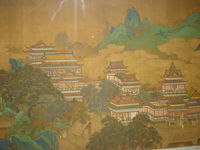
Peach Festival of the Queen Mother of the Westward, early seventeenth century, Ming Dynasty.

Chinese culture bloomed during the Ming dynasty. Narrative painting, with a wider color range and a much busier limerick than the Song paintings, became very pop. As techniques of colour printing were perfected, illustrated manuals on the art of painting began to be published. Jieziyuan Huazhuan (Manual of the Mustard Seed Garden), a five-volume work first published in 1679, has been in use as a technical textbook for artists and students ever since.
Wen Zhengming (Traditional Chinese: 文徵明; Simplified Chinese: 文征明; Hanyu Pinyin: Wén Zhēngmíng; Wade-Giles: Wen Cheng-ming, 1470–1559), a leading Ming Dynasty painter and calligrapher, painted subjects of great simplicity, such as single trees or rocks. His discontent with official life is expressed every bit a feeling of strength through isolation in his works. Many of his works celebrate the contexts of elite social life for which they were created.
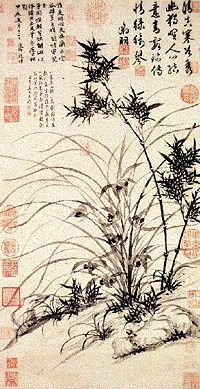
Painting past Wen Zhengming
Xu Wei (Chinese: 徐渭; pinyin: Xú Wèi, 1521—1593), a Ming Chinese painter, poet and dramatist, is considered the founder of modernistic painting in China. Revolutionary for its time, his painting fashion influenced and inspired countless subsequent painters, such as Zhu Da, the Eight Eccentrics of Yangzhou, and the modern masters Wu Changshuo and Qi Baishi.
Matteo Ricci (October 6, 1552 – May xi, 1610; Traditional Chinese: 利瑪竇; Simplified Chinese: 利玛窦; pinyin: Lì Mǎdòu; courtesy name: 西泰 Xītài), an Italian Jesuit priest, arrived in People's republic of china in 1583 and introduced Western geography, science, music, painting and technology for the first fourth dimension to Chinese scholars.
Qing drama
The best-known form of Chinese opera, Beijing opera, assumed its present form in the mid-nineteenth century and was popular during the Qing Dynasty (1644–1911). It originated in the Chinese provinces of Anhui and Hubei. Its two master melodies, Xipi and Erhuang, come from Anhui and Hubei operas, and much of the dialogue is carried out in an archaic dialect originating partially from those regions. Information technology is commonly believed that Beijing Opera was born when the 4 Bang-up Anhui Troupes came to Beijing in 1790. Originally staged for the court, it later became a form of public amusement. In 1828, some famous Hubei troupes came to Beijing, where they performed on stage with Anhui troupes. Beijing opera's principal melodies evolved from this combination. Music and arias were besides absorbed from other operas and musical arts such every bit the historic Qinqiang.
In Beijing Opera, traditional Chinese cord and percussion instruments provide a strong rhythmic accompaniment to the acting, in which stylized gestures, footwork, and other body movements limited such actions as riding a equus caballus, rowing a boat, or opening a door.
Qing poetry
Yuan Mei, a well-known poet who lived during the Qing Dynasty, produced a large torso of poesy, essays and paintings. His works reflected his interest in Zen Buddhism and the supernatural, at the expense of Daoism and institutional Buddhism—both of which he rejected. Yuan is most famous for his poetry, which has been described as "unusually clear and elegant language." His views on poetry, elaborated on in the Suiyuan shihua (隨園詩話), stressed the importance of personal feeling and technical perfection.
Early Qing painting

The Yongzheng Emperor Enjoying Himself During the eighth Lunar Calendar month, by anonymous court artists, 1723-1735 C.Due east., Palace Museum, Beijing.
Bada Shanren (Template:Zh-cwl, (ca. 1626—1705), born as Zhu Da (朱耷), was a calligrapher and ink-and-wash (shuimohua) painter. His paintings feature sharp brush strokes which are attributed to the sideways way by which he held his brush.
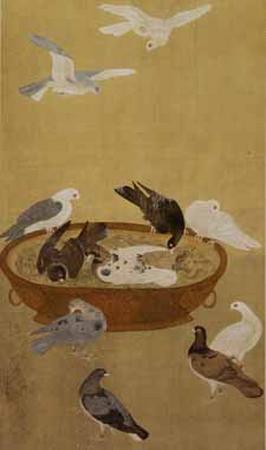
"Xi Pigeons" painting by Jiang Tingxi
Jiang Tingxi (Traditional Chinese: 蔣廷錫; Simplified Chinese: 蒋廷锡; Hanyu Pinyin: Jiǎng Tíngxí; Wade-Giles: Chiang T'ing-hsi, 1669–1732), courtesy proper noun Yangsun (杨孙), was an editor of the 5020-volume state-sponsored encyclopedia Gǔjīn Túshū Jíchéng (Traditional Chinese: 古今圖書集成; Simplified Chinese: 古今图书集成; literally "Complete Collection of Illustrations and Writings from the Earliest to Electric current Times"), published in 1726 and compiled in collaboration with Chen Menglei during the reigns of Qing emperors Kangxi and Yongzheng. An official painter and grand secretary to the Imperial Court in Kyoto, Jiang Tingxi used a broad diversity of creative styles, and focused particularly on paintings of birds and flowers. He was also skilful in calligraphy.
Yuanji Shih T'ao (born Zhu Ruoji (1642 - 1707) was a fellow member of the Ming royal house who narrowly escaped in 1644 when the Ming dynasty roughshod to invading Manchurians and ceremonious rebellion. He assumed the name Yuanji Shih T'ao and became a Buddhist monk, then converted to Daoism in 1693. One of the most famous individualist painters of the early Qing dynasty, he transgressed the rigidly codification techniques and styles of painting tradition. His formal innovations include cartoon attention to the deed of painting itself through the employ of washes and bold, impressionistic brushstrokes; an involvement in subjective perspective; and the utilize of negative or white space to advise altitude.
Shanghai School (1850 – 1890)
After the bloody Taiping rebellion broke out in 1853, wealthy Chinese refugees flocked to Shanghai where they prospered by trading with British, American, and French merchants in the foreign concessions in that location. Their patronage encouraged artists to come to Shanghai, where they congregated in groups and art associations and developed a new Shanghai manner of painting. The new cultural environment, a rich combination of Western and Chinese lifestyles, traditional and mod, stimulated painters and presented them with new opportunities.[10]The Shanghai School (海上画派 Haishang Huapai or 海派 Haipai) challenged the literati tradition of Chinese art, while paying technical homage to the ancient masters and improving on existing traditional techniques. One of the most influential painters of the Shanghai school was Ren Xiong. Members of the Ren family and their students produced a number of innovations in painting between the 1860s and the 1890s, particularly in the traditional genres of effigy painting and bird-and-bloom painting.
In an era of rapid social change, works from the Shanghai School were widely innovative and various, and often contained thoughtful yet subtle social commentary. The most well-known figures from this school are Ren Xiong (任熊), Ren Yi (任伯年, also known every bit Ren Bonian), Zhao Zhiqian (赵之谦), Wu Changshuo (吴昌硕), Sha Menghai (沙孟海, calligrapher), Pan Tianshou (潘天寿), Fu Baoshi (傅抱石). Other well-known painters are: Wang Zhen, XuGu, Zhang Xiong, Hu Yuan, and Yang Borun.

Peonies and Daffodils (牡丹水仙图), Wu Changshuo, Jilin Provincial Museum
Qing fiction
Many great works of fine art and literature originated during the period, and the Qianlong emperor in particular undertook huge projects to preserve important cultural texts. The novel became widely read and Dream of the Scarlet Chamber, past Cao Xueqin, perhaps Cathay's most famous novel, was written in the mid-eighteenth century. Handwritten copies of this work, consisting of 80 capacity, were in circulation in Beijing soon after Cao's death, before Gao Ê, who claimed to have access to the quondam's working papers, published a consummate 120-chapter version in 1792.
Pu Songling was a famous writer of Liaozhai Zhiyi 《聊齋志異》during the Qing dynasty. He opened a tea firm and invited his guests to tell stories, and then compiled the tales in collections such as Foreign Stories from a Chinese Studio.
New Mainland china Art (1912-1949)
Transformation
Subsequently the end of the final dynasty in Mainland china, the New Civilisation Movement (1917 – 1923) defied all facets of traditionalism. A new breed of twentieth century cultural philosophers including Xiao Youmei, Cai Yuanpei, Feng Zikai and Wang Guangqi chosen for Chinese civilization to modernize and reflect the "New China." The Chinese Civil War (1927 – 1950) brought nearly past a carve up betwixt the Kuomintang and the Communist Party of China, and the Second Sino-Japanese War (1937 – 1945), in item the Battle of Shanghai, threw the Chinese fine art and cultural worlds into tumult. Nevertheless, several of import developments of Chinese modernistic art took place during this period.
The Big Three
Shanghai became an entertainment eye and the birthplace of the three new art forms, Chinese movie theatre, Chinese blitheness and Chinese popular music. Heavily inspired past Western engineering, Chinese artists adapted it to Chinese culture in a positive way.
The introduction of gramophone engineering science gave ascension to shidaiqu (時代曲, "music of the time"), popular songs with Mandarin lyrics influenced by Western jazz. Composer Li Jinhui, regarded as the male parent of Chinese popular music, organized the Brilliant Moonlight Song and Dance Troupe which merged with the Mainland china Picture show Company in 1931. This troupe groomed several of the "seven great singing stars of the Commonwealth of China" (Chinese: 七大歌星; pinyin: qī dà gēxīng ), female vocalists who produced hundreds of recordings equally well as acting in musical films.
Comics
The near popular class of comics, lianhuanhua, circulated as palm sized books in Shanghai, Guangzhou, Wuhan and Northern Communist china. Comic books became one of the most affordable forms of entertainment. The famous Sanmao character was born at this time.
Painting
In the late 1800s and 1900s, Chinese painters were increasingly exposed to the Western art, and an artistic controversy arose over how to respond to it. Some artists who studied in Europe rejected Chinese painting; others tried to combine the best of both traditions. Qi Baishi (Simplified Chinese: 齐白石; Traditional Chinese: 齊白石; pinyin: Qí Báishí, as well Ch'i Pai-shih) (Jan 1, 1864 - September xvi, 1957) began life every bit a poor peasant and became a corking painter of flowers and small animals and is known for the whimsical, often playful way of his watercolors.
Equally an extension of the New Civilisation Motion Chinese artists started to prefer Western painting techniques. and oil painting was introduced to China. Some artists, including Zhang Daqian, Lin Fengmian, Pang Xunqin and Wu Zuoren, studied or worked abroad.
Guohua
Every bit part of the endeavour to Westernize and modernize Prc during the first half of the twentieth century, art education in China'due south modern schools taught European artistic techniques, which educators considered necessary for technology and science. Painting in the traditional medium of ink and colour on paper came to be referred to equally guohua (国画, significant 'national' or 'native painting'), to distinguish it from Western-style oil painting, watercolor painting, or cartoon. Various groups of traditionalist painters formed to defend and reform China'south heritage, believing that innovation could exist achieved inside Prc's ain cultural tradition. Some of them recognized similarities between Western modernism and the cocky-expressive and formalistic qualities of guohua, and turned to modernist oil painting. Others believed that the all-time qualities of Chinese civilization should never be abandoned, merely did not agree on what those qualities were.
One group of guohua painters, including Wu Changshi, Wang Zhen, Feng Zikai, Chen Hengke, and Fu Baoshi, were influenced by similar nationalistic trends in Nippon and favored simple merely bold imagery. Wu Hufan, He Tianjian, Chang Dai-chien and Zheng Yong, based their piece of work upon a render to the highly refined classical techniques of the Vocal and Yuan periods. A tertiary group, dominated by Xu Beihong, followed the footsteps of the Lingnan school in trying to reform Chinese ink painting by adding elements of Western realism.
Communist fine art (1950-1980s)
After the establishment of the People'due south Democracy of Red china in 1949, the Communist Political party of China took full control of the authorities and established the Cardinal Academy of Fine Arts and the Chinese Artists' Association to directly creative policy. Art was treated as a vehicle for credo. Artists who did not comply with government policies were punished and sent to rural areas to exist "re-educated" every bit farmers.
During Mao Zedong'south Cultural Revolution (1966 – 1976), fine art schools were airtight, and publication of fine art journals and major art exhibitions ceased. Many artists and intellectuals were exiled, lynched or imprisoned. Some traditional arts almost disappeared. Equally role of the Destruction of the Four Olds campaign," museums and temples were pillaged and art treasures such every bit pottery, statuary and paintings were defaced and destroyed, not only in mainland Red china simply too Tibet.
Following the Cultural Revolution, fine art schools and professional organizations were reinstated. Exchanges were fix with groups of foreign artists, and Chinese artists began to experiment with new subjects and techniques.
The loss of the Big 3
The Communist regime quickly classified popular music equally yellowish music (pornography), and began to promote revolutionary music (guoyue) instead. Many filmmakers, artists, and popular musicians immigrated to Hong Kong, Taiwan and Japan, where they fueled the development of modern Chinese art.
Painting
Artists were encouraged to employ socialist realism. Some Soviet Union socialist realism was directly imported, and painters were assigned subjects and expected to mass-produce paintings. This regimen was considerably relaxed in 1953, and after the Hundred Flowers Campaign of 1956–57, traditional Chinese painting experienced a significant revival. Along with these developments in professional person art circles, in that location was a proliferation of peasant fine art depicting everyday life in the rural areas on wall murals and in open-air painting exhibitions. Notable modern Chinese painters include Huang Binhong, Qi Baishi, Xu Beihong, Chang Ta Chien, Pan Tianshou, Wu Changshi, Fu Baoshi, Wang Kangle and Zhang Chongren.
Poetry
Modern Chinese poems (新詩, free verse) usually exercise not follow any prescribed pattern. Bei Dao is the almost notable representative of the Misty Poets, a grouping of Chinese poets who reacted against the restrictions of the Cultural Revolution. The piece of work of the Misty Poets and Bei Dao in particular were an inspiration to pro-commonwealth movements in Communist china. Most notable was his verse form "Huida" ("The Answer"), which was written during the 1976 Tiananmen demonstrations in which he participated. The poem was taken up as a defiant canticle of the pro-appeared on posters during the Tiananmen Square protests of 1989.
Xu Zhimo is a romantic poet who loved the poetry of the English Romantics like Keats and Shelley. He was one of the starting time Chinese writers to successfully naturalize Western romantic forms into modern Chinese poesy.
Redevelopment (Mid-1980s - 1990s)
Contemporary Art
Gimmicky Chinese art (中国当代艺术, Zhongguo Dangdai Yishu), oft referred to as Chinese avant-garde art, has continued to develop since the 1980s, when the restrictions of the Cultural Revolution were lifted. Contemporary Chinese fine art incorporates painting, film, video, photography, and operation. Until recently, art exhibitions accounted controversial were routinely close down past police, and performance artists in item faced the threat of abort during the early 1990s. More recently there has been greater tolerance by the Chinese government, though many internationally acclaimed artists are still restricted from media exposure at home or have their exhibitions airtight by government order. Leading gimmicky visual artists include Ai Weiwei, Cai Guoqiang, Cai Xin, Fang Lijun, Huang Yan, Huang Yong Ping, Kong Bai Ji, Lu Shengzhong, Ma Liuming, Ma Qingyun, Vocal Dong, Li Wei, Christine Wang, Wang Guangyi, Wang Qingsong, Wenda Gu, Xu Bing, Yang Zhichao, Zhan Wang, Zhang Dali, Zhang Xiaogang, Zhang Huan, Zhu Yu, Yan Lei, and Zhang Yue.
Visual art
First in the late 1980s younger Chinese visual artists received unprecedented exposure in the Due west through Chinese museum curators based outside the country. Museum curators inside China, such equally Gao Minglu, and critics such as Li Xianting (栗宪庭) take reinforced the promotion of item newly-emerged brands of painting, and spread the idea of art as a strong social forcefulness inside Chinese culture. Critics contend that these curators are exercising personal preferences and that the majority of avant-garde Chinese artists are alienated from Chinese officialdom and the patronage of the Western art marketplace.
Contemporary Chinese fine art market
The new visual art market
The market for Chinese art, both contemporary and aboriginal, has exploded in recent years. Globalization has increased Western awareness of and appreciation for Chinese fine art, and the growth of a wealthy center course in People's republic of china has created a new market within People's republic of china. In 2008, China overtook France every bit the world'southward tertiary-largest fine art market, after the United States and the United Kingdom.[11] [12]The 798 Art Commune, or Dashanzi, in East Beijing, where artists and dealers work out of Bauhaus-style factories built in the 1950s, has grown and then popular since it surfaced six years agone that it is jammed with visitors on weekends. In that location are an estimated 20,000 artists in the Peoples' Republic of China and one thousand more graduate every year[xiii].
A 1993 painting, "Tiananmen Foursquare" by Zhang Xiaogang sold for USD $2.3 million in Hong Kong in 2006. A 1964 painting "All the Mountains Blanketed in Red" was sold for HKD $35 million. Sotheby's auctioned Xu Beihong's 1939 masterpiece "Put Downward Your Whip" for United states of america $9,220,839 [xiv]. In 2006 Christie's sold a Chinese porcelain bowl with the mark of Emperor Qianlong for US $19,376,569[xv]. At that place is concern that increased competition is driving prices artificially high, and that buyers are too inexperienced to distinguish valuable pieces from forgeries or second-charge per unit art.
Encounter also
- History of Communist china
- Chinese art
- Chinese painting
- Shan shui
Notes
- ↑ Anneliese Bulling. The Ornament of Mirrors of the Han Flow: A Chronology. (Ascona: Artibus Asiae, 1960), 22.
- ↑ Bulling, (1960), 52.
- ↑ Bulling, (1960), 51.
- ↑ Latest Discovery Challenges Red china's Long-term Newspaper-making Theory. May xiii, 2002. [1]people daily. Retrieved October xi, 2008.
- ↑ half dozen.0 six.1 Joseph Needham. Chemistry and Chemical Engineering. (1974) (Cambridge Academy Press. ISBN 0521086906)
- ↑ Robert James Lang. The Complete Book of Origami: Pace-by Step Instructions in Over grand Diagrams/48 Original Models. (Courier Dover Publications. 1988. ISBN 0486258378)
- ↑ viii.0 eight.1 viii.2 Joseph Needham, (1986). Science and Culture in Red china: Book 4, Physics and Physical Engineering science, Office 3: Civil Technology and Nautics. (Taipei: Caves Books, Ltd.), Plate CCCXII
- ↑ 'Keith Bradsher, 'New York Times 'China's Mona Lisa' Makes a Rare Appearance in Hong Kong The New York Times, (July 3, 2007) Retrieved September 3, 2008.
- ↑ Dr. Julia Andrews and Kuiyi Shen. Guggenheim Museum of Fine art: Showroom of Mod Chinese Painting Ohio Land Academy. retrieved August 23, 2008.
- ↑ Tom Spender (May 2, 2008) Civilization and art Beijing mode Emirates Business concern 24-7. Retrieved September 3, 2008.
- ↑ Reshmi Dasgupta, The Economic Times China fashion alee of India in Gimmicky art, The Economic Times, March 11, 2008. Retrieved September 3, 2008.
- ↑ Adrienne Mong, (May 29, 2007). China's Fine art Scene MSNBC. Retrieved on September 3, 2008.
- ↑ Le-Min Lim, (May 29, 2007) Stanley Ho Buys Chinese Emperor's Throne for HK$13.7 Million. Bloomberg. Retrieved September three, 2008.
- ↑ Adrienne Mong, (May 29, 2007). People's republic of china's Art Scene MSNBC Retrieved on September 3, 2008.
References
ISBN links support NWE through referral fees
- Barnhart, Richard M., et al. Three G Years of Chinese Painting. Wadsworth Atheneum Museum of Fine art: 2002. ISBN 0300094477.
- Bulling, Anneliese. The Ornament of Mirrors of the Han Flow: A Chronology. Ascona: Artibus Asiae, 1960.
- Chi, Lillian, et al. A Dictionary of Chinese Ceramics. Sun Tree Publishing: 2003. ISBN 9810460236.
- Clunas, Craig. Art in China. Oxford University Press: 1997. ISBN 0192842072.
- Ebrey, Patricia, et al. Taoism and the Arts of China. Academy of California Press: 2000. ISBN 0520227840.
- Gowers, David, et al. Chinese Jade from the Neolithic to the Qing. Art Media Resources: 2002. ISBN 1588860337.
- Harper, Prudence Oliver. Cathay: Dawn Of A Golden Historic period (200-750 C.E.). Yale University Press: 2004. ISBN 0300104871.
- Lang, Robert James. The Complete Book of Origami: Stride-past Pace Instructions in Over 1000 Diagrams/48 Original Models. Courier Dover Publications, 1988. ISBN 0486258378.
- Mascarelli, Gloria, and Robert Mascarelli. The Ceramics of China: 5000 B.C.E. to 1900 C.E. Schiffer Publishing: 2003. ISBN 0764318438.
- Needham, Joseph. Chemistry and Chemical Technology. Cambridge University Press, 1974. ISBN 0521086906
- Sturman, Peter Charles. Mi Fu: Style and the Art of Calligraphy in Northern Vocal Prc. Yale University Printing: 2004. ISBN 0300104871.
- Sullivan, Michael. The Arts of China, Quaternary edition. University of California Press: 2000. ISBN 0520218779.
- Tregear, Mary. Chinese Art. Thames & Hudson: 1997. ISBN 0500202990.
- Watson, William. The Arts of China to Ad 900. Yale Academy Press: 1995. ISBN 0300059892.
- Chinese Paintings, Chi Baishi Album Paintings, MSN. Retrieved September iii, 2008.
- Chinese Art and Architecture, MSN Encarta. Retrieved September 3, 2008.
- Chinese fine art, The Columbia Electronic Encyclopedia. Retrieved September 3, 2008.
External links
All links retrieved January 10, 2018.
- Joshua Hough. Art History of Chinese calligraphy, painting, and seal making
- Ancient Chinese Civilization and Art: Early Civilization to the Han Dynasty
biggersmardenes71.blogspot.com
Source: https://www.newworldencyclopedia.org/entry/History_of_chinese_art
0 Response to "The Meaning of Chinas Most Ancient Art an Interpretation of Pottery By Anneliese Bulling"
Post a Comment