Chrysler Museum of Art Norfolk Va Third Class Carrige
After 16 months of construction, a newly renovated and expanded Chrysler Museum of Art reopened in Norfolk, Virginia, earlier this month. Boasting a newly-flush endowment that allows information technology to offer free admission to all, and an expansive and encyclopedic collection, the new Chrysler is an exceptionally welcoming institution, eager to engage the with the community just also to participate in the international art scene.
Not many museums have been as lucky as the Chrysler. In 1971, the pocket-size, regional institution—still known, since its 1933 founding, as the Norfolk Museum of Arts and Sciences—received a princely gift: the fine art collection of Walter Chrysler Jr., son of the auto magnate and husband to local girl Jean Esther Outland. Overnight, the museum became domicile to a world-class art collection, merely finding space for all of information technology has been a challenge ever since.
Despite expansions in 1974 and 1989, museum director Bill Hennessey still had "wonderful things in storage that deserved to be shown—but there weren't enough walls!" As Hennessey points out, it's hard to solicit donations when newly acquired works have nowhere to get but a warehouse. The expansion latest project addressed this issue by calculation two-story wings to either side of the museum'due south palazzo-manner entrance, for a total of x,000 additional square feet of exhibition space.
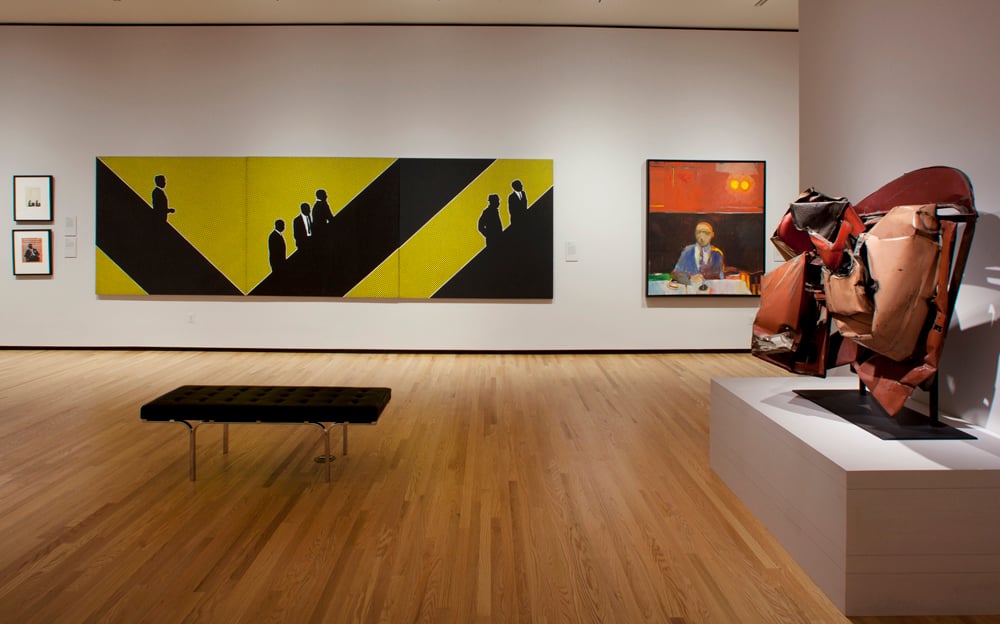
An installation view of the contemporary and modern art galleries featuring a recent acquisition, Idelle Weber'southward Munchkins I, Two, & II (1964), a Richard Diebenkorn painting, and a John Chamberlain Combine, amongst other works.
There was also a significant overhaul of the museum's existing galleries, which have been completely rehung, incorporating technological advances in lighting, heating, ac, video, and wireless. The improvements are almost conspicuous in the museum'due south modern and contemporary galleries, which now avowal higher ceilings and movable walls, allowing the space to be reconfigured depending on what'southward on view.
Whereas the largest works in the museum's holdings had previously been much too big for its facilities (the curatorial team likens the experience of trying to see these oversize paintings to craning your cervix in the front end row of the pic theater), the renovated galleries have college ceilings and offer meliorate, more comfortable vantage points for appreciating massive works.
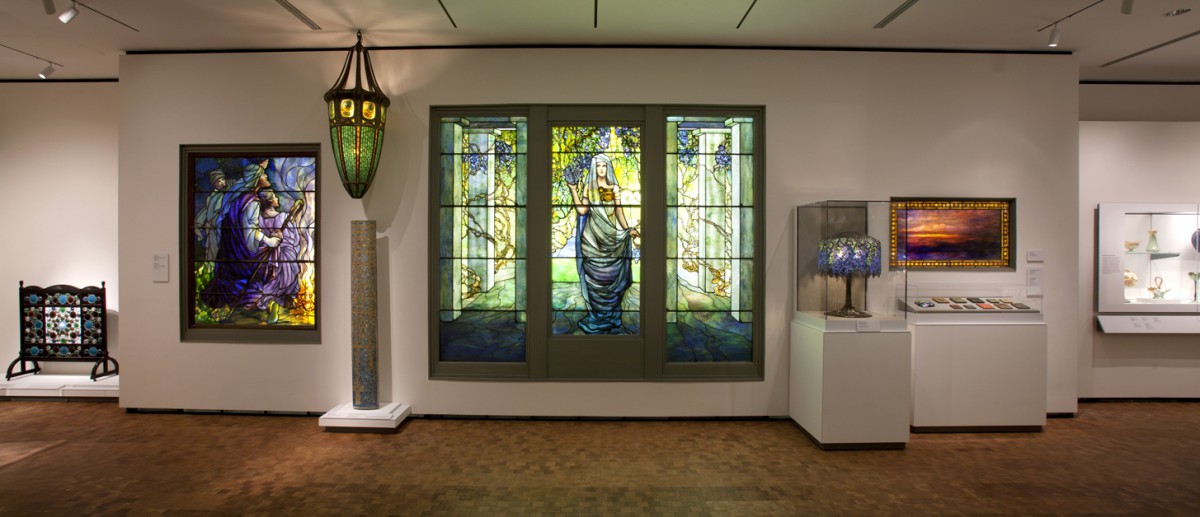
Louis Comfort Tiffany glass.
Walter Chrysler had two main passions in his collecting: early European modernism, and glass. He eventually traded many of his modernist works, including hundreds of Picassos, in order to aggregate a more encyclopedic drove. He was intent on creating a lasting legacy for the Chrysler name through the museum, and thank you to his all-encompassing glass holdings,the Chrysler has more works in the medium than any other institution in the land, save the Corning Museum of Glass. Of the 30,000 slice collection, a full tertiary of it is drinking glass, ranging from ancient Egyptian beads to monumental contemporary works.
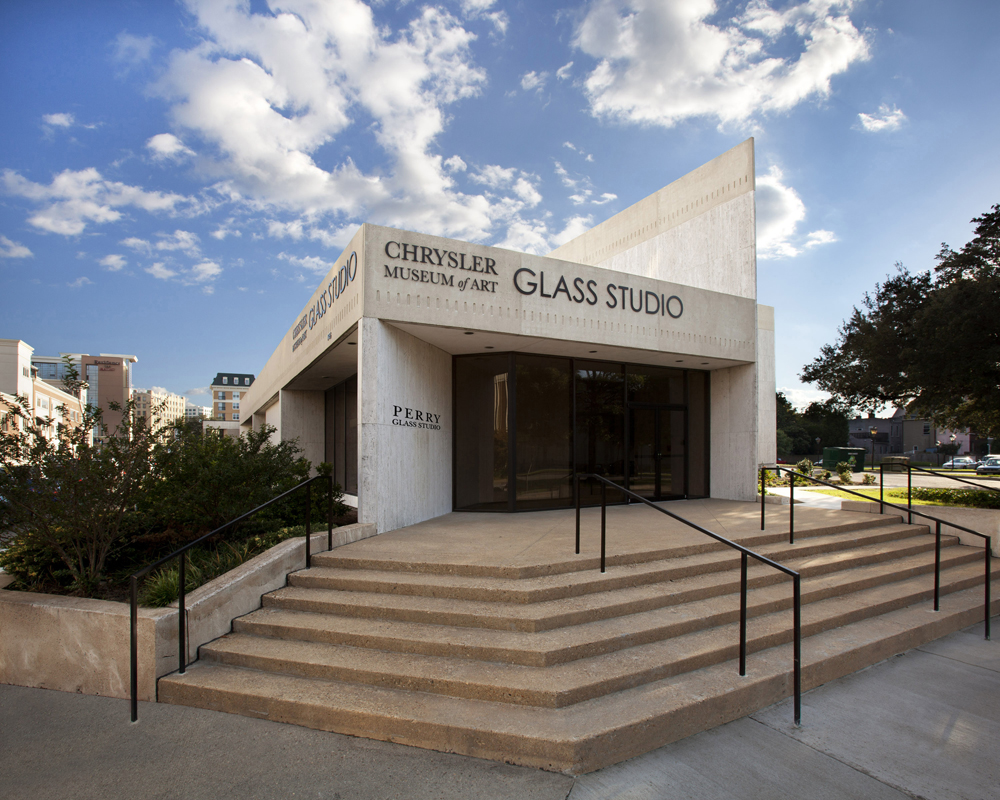
The museum's glass studio.
While the museum was closed, it kept an active presence within the community through its ii-twelvemonth-old Perry Drinking glass Studio, which hosts complimentary daily demonstrations and a number of classes geared toward a broad range of skill levels. A video feed inside the glass galleries streams live action of work in the studio, which encompasses a variety of techniques. The museum is keen on promoting an understanding of glass blowing every bit a course of performance art, not only as a production-oriented process, which it does through its Third Thursday evening serial pairing glass working with alive music. Beginning in June, 3rd Thursday programming will expand to the Chrysler proper, and the unabridged museum will stay open late.
The museum'due south curatorial staff accept revamped each of the drove'due south major sections: American painting and sculpture, European painting and sculpture, drinking glass, photography, ancient artifacts, and modernistic and contemporary. The Chrysler's decorative art holdings are incorporated throughout, rather than being confined to their own area.
The new hanging plays to the drove's strengths, with salient pieces from its contemporary holdings installed in galleries devoted to older works. In the aboriginal galleries, massive marble sculptures, with their trademark draped garments, benefit from the inclusion of a life-size frosted glass cast of a woman in a heavily draped dress by Karen LaMonte from 2009. In the medieval galleries, portraits past Hans Holbein the Edler and his ilk are paired with two large photo prints from contemporary artist res that depict heavily on medieval portraiture conventions in their compositions and the subjects' attire.
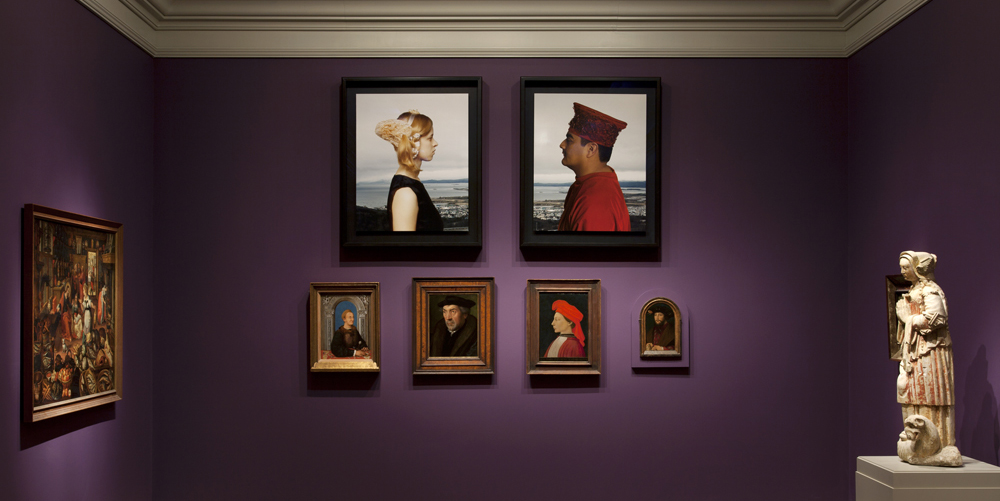
Gimmicky photography by res with medieval portraiture. Photo: Ed Pollard, courtesy Chrysler Museum of Art, Norfolk, Virginia.
Throughout, artworks are grouped thoughtfully, creating memorable juxtapositions. A peculiarly spooky combination brings together ii takes on the mother-and-child portrait motif: One, Léon-Jean-Bazile Perrault'sThe Orphans, shows an adoring young woman cradling a toddler in her artillery; the other, Hugues Merle French'due southThe Lunatic of Étretat, features a wild-eyed gypsy clutching a log she'due south outfitted with a baby bonnet. It'due south a great pairing of maternal love and unhinged grief. Less engaging is a trio of black paintings in the mod and contemporary galleries past Pierre Soulages, Adam Pendleton, and Jackson Pollock.
In the American galleries, a massive Hudson River Valley Schoolhouse painting by Albert Bierstadt receives a showy presentation. The Emerald Pool(1870) is hung under a red velvet theater curtain. It's an over-the-top gimmick, but historically accurate to an era when going to encounter a painting was a popular source of amusement on par with today's blockbuster movies. The piece of work, which depicts New Hampshire's White Mountains, is paired with photographs taken by the artist's blood brother, Edward, of the regal view. His unique stereoscopic book presents a number of scenic New England vistas.
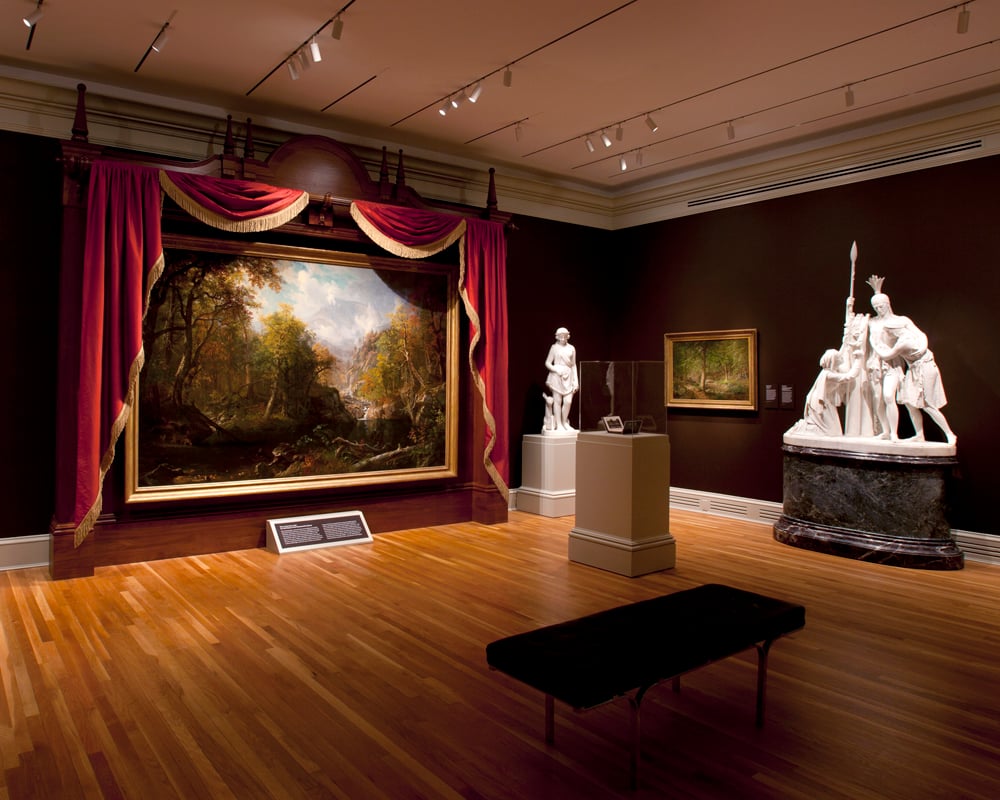
Albert Bierstadt, The Emerald Pool (1870), on display.
The museum has also introduced an interactive sound-based iPad app from the educational activity section in a fun spin on the traditional audio guide. The app, not yet available for download, works with several pieces in the collection. Museum guides volition hold an iPad up to a painting or sculpture, and a related piece of music or sound will play, such every bit a bird song for Winslow Homer'sSong of the Distraction(1876), or, for a glass chiliad harmonicona, a song played on the blowsy musical instrument.
The sound art initiative is reflective of the museum's mission to engage viewers, to encourage them to recall near art in new means, and to make connections across the collection. There'southward a lot to see at the Chrysler, an in spite of all its extra infinite, it remains a manageable, accessible collection that doesn't daunt or overwhelm. In many ways, the renovated museum retains the soul of a welcoming small-scale town institution—fifty-fifty after the departure of Florentijn Hoffman's Safety Duck—that can finally showcase the total breadth of Walter Chrysler's earth-class collection.
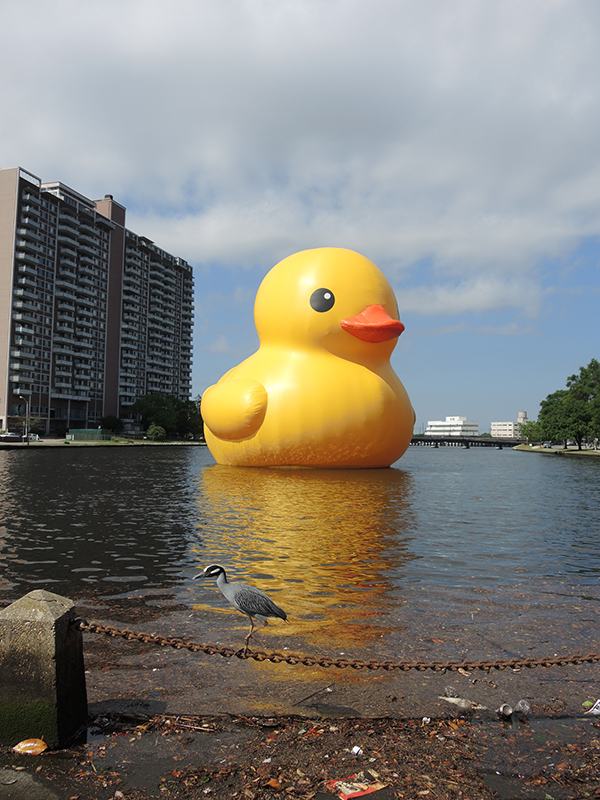
Florentijn Hoffman, Rubber Duck, exterior the Chrysler Museum of Art, Norfolk, Virginia.
Photo: Sarah Cascone.
Follow Artnet News on Facebook:
Want to stay ahead of the art world? Subscribe to our newsletter to become the breaking news, eye-opening interviews, and incisive disquisitional takes that drive the conversation forward.
biggersmardenes71.blogspot.com
Source: https://news.artnet.com/art-world/tuned-up-chrysler-museum-shines-in-virginia-22840
0 Response to "Chrysler Museum of Art Norfolk Va Third Class Carrige"
Post a Comment